Would You Run an Apple "iOS" on "Android" Phone?
Tahirat Nasiru, LCSW
3/3/202612 min read


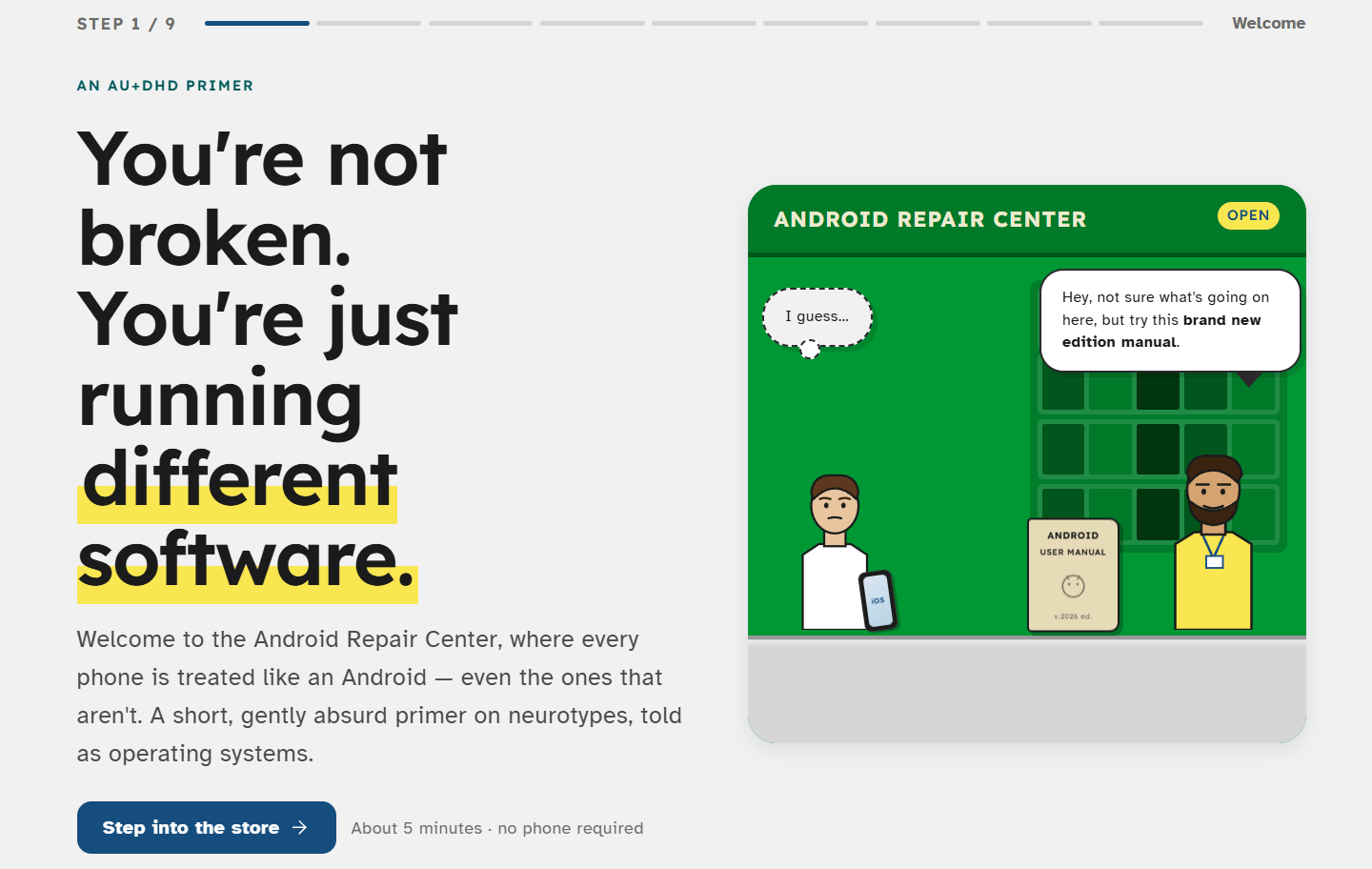
I. First Try The Interactive Explainer
II. Read The Details
Imagine our minds are like smartphones.
An iPhone and an Android both make calls, run apps, and connect to the internet. They serve the exact same purpose. But their internal software architectures are fundamentally different. You can't run an iOS app on an Android, and you wouldn't go to an Android store to fix an iPhone. They require different manuals, different troubleshooting, and different environments to thrive.
Now, apply that to human minds.
A neuro-distinct mind ( aka neurodivergent mind) (like ADHD, Autism, or AuDHD) runs on one operating system—let's call it iOS.
A neuro-conforming mind ( aka neurotypical mind) runs on another—let's call it Android.
Neither is defective nor "broken" version of the other. They are simply built on different internal logics, with different rules, different sensory filters, and different ways of processing information.
The problem is, society assumes we are all running the same OS.
So when someone's brain operates differently, when their system processes input differently, responds to stress differently, or communicates in a language all its own, they are often handed strategies designed for a system they do not actually run.
And when those strategies do not work, the failure is often placed on the individual rather than on the mismatch. But here is the truth: the system is not broken. It is just different.
This is because awareness simply has not caught up yet.
Recognizing this difference is not about creating division; it is about understanding the operating system so you can use the right apps, conserve energy, and optimize performance.
Disclaimer: In this analogy, we are using Android as the 'Standard' simply because it is the most widely used globally, but the specific brand matters less than the fact that the code is written differently.
Definitions & Distinctions
Neuro-conforming, also known as neurotypical, just means minds and nervous systems that effortlessly absorb and adapt to whatever cultural and sensory environment they are placed in. They are able to conform more easily to what society decided is standard. Neuro-conforming individuals also tend to possess a highly neuro-adaptive nervous system, one that habituates quickly to sensory changes and recalibrates with relative ease.
This is not regarded as better. If your brain's development, social style, sensory processing, and attention patterns adapt more easily to what most people expect as normal, then you fall under the umbrella of neuro-conforming or neurotypical, which is an out-dated term.
Neuro-distinct or neuro-divergent means your brain works a bit differently from neuro-conforming minds. Your mind runs on consistent, intrinsic architecture and requires stable, predictable, and regulated environments to function optimally. These minds do not habituate to chaos; they translate it, survive it, and often pay a heavy physiological price for doing so.
Examples are Autism, ADHD, dyslexia, Tourette's, OCD, and dyspraxia. These are all forms of neurodivergence or neuro-distinct minds. Your brain is wired differently at a pretty fundamental level.
Neuro-conforming does not mean normal and neurodivergent does not mean broken.
Think of it like operating systems. Neuro-conforming is Windows. Neurodivergent is macOS or Linux. They are not wrong; they just run differently. A Mac does not struggle because it is inferior. It struggles when you try to force it to run Windows software in an environment designed exclusively for Windows.
Same brain. Same person. Different environment changes everything.
The one big mistake people make
They treat neuro-conforming as the default and neurodivergent as the exception, as though the world was built one way and everyone else just has to cope.
But here is the thing: there is no such thing as a standard brain. No one is perfectly neuro-conforming any more than anyone is perfectly average height. We are all somewhere on spectrums. The terms are just shortcuts for describing where someone tends to land.
So why does the distinction matter?
Because when you are neuro-distinct or neurodivergent, the world feels like it was built for someone else. The school schedule, the open office, the eye contact expectation, and the unwritten social rules were none of it made with your brain in mind. And you spend an enormous amount of energy just trying to keep up. That energy is called masking. And it is exhausting.
A neuro-conforming person rarely has to think about any of this. The water they are swimming in just fits.
Common Traits of the Neuro-conforming mind :
Social Interaction: They have an intuitive understanding of unspoken social cues such as facial expressions, tone of voice, and body language. It feels automatic.
Sensory Processing: They generally tolerate sensory input such as loud sounds, bright lights, and itchy tags without significant distress or overload.
Learning and Focus: They tend to adapt well to traditional education and work environments. They can maintain focus amid moderate distractions and follow structured routines.
Emotional Regulation: They usually express emotions in ways that match social expectations and often prioritize group harmony.
Flexibility: They can adjust easily to changes in routine or environment without major emotional dysregulation.
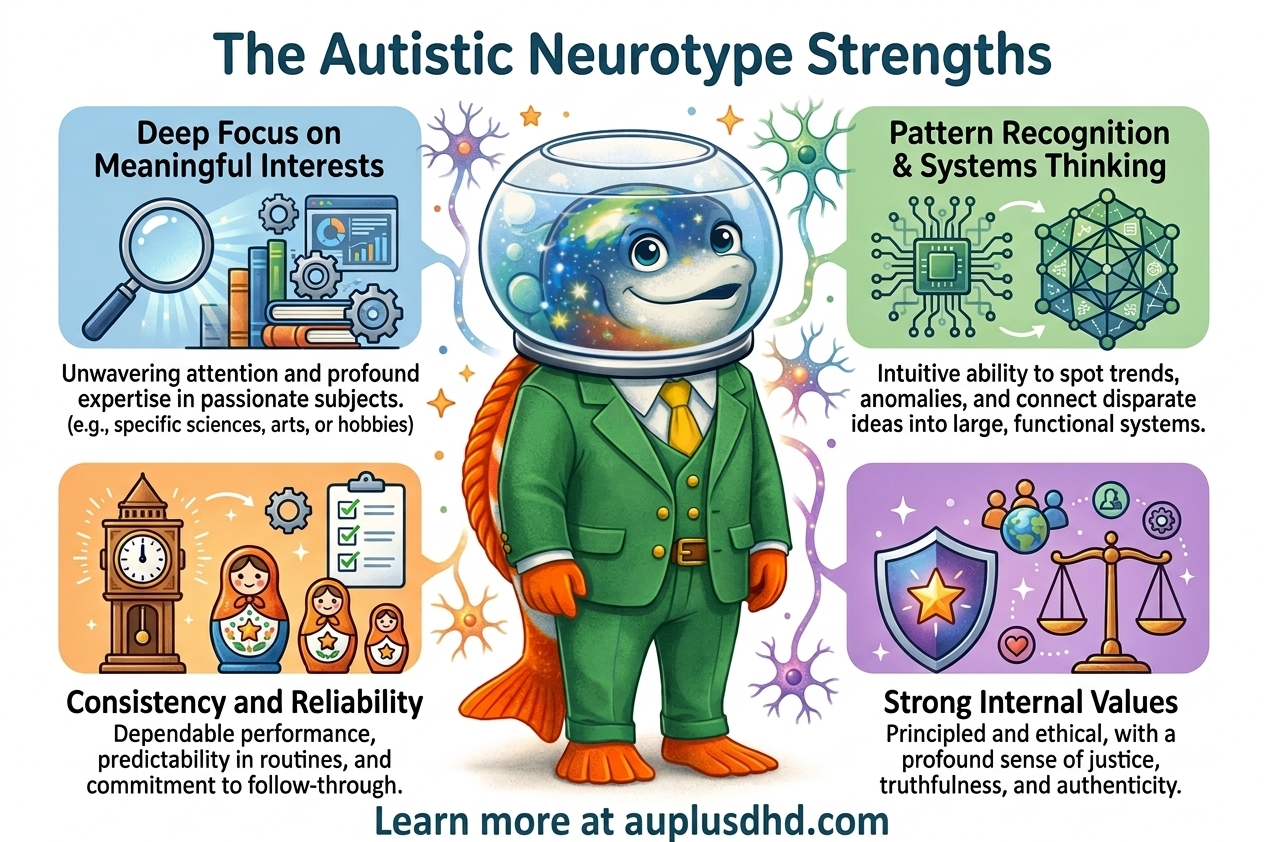
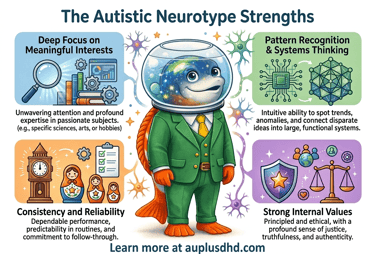
Understanding The Autistic Mind: The Deep Focused Immersive Mind
Think of the autistic mind as a high-powered laser beam.
While many minds naturally spread their attention across several things at once, the autistic mind pulls all of its brainpower into one single thought, interest, or feeling at a time. This single-focus style is called monotropism. Monotropism is a tendency to focus attention intensely on a small number of interests at any given moment, rather than distributing it broadly.
What this looks like inside:
Depth over breadth (Goes all in). When an autistic person gets interested in something, they don't just "like" it—they dive completely into it. Their brain naturally gathers every single detail, rule, and piece of information about that topic and locks it in. It doesn't feel like a choice; it feels like gravity pulling their mind directly to that one spot.
Bottom-up processing (building the picture piece by piece). Most brains automatically ignore background noises or sights to see the "big picture." The autistic brain doesn't have that automatic filter. Instead, it builds the world from the ground up, piece by piece. For example, they don't just see a whole forest at once; they notice every single leaf, tree trunk, and bug first, and then glue those pieces together to understand the forest. This is why a loud or bright room can cause sensory overload. It isn't just a simple annoyance, rather, it causes a brain overload because the mind is forced to process every single sound and sight all at once.
Predictability as a survival and rest mechanism.Because building the world piece-by-piece takes a massive amount of energy, the autistic nervous system needs routines and predictability to rest. When things change without warning, it forces the brain to suddenly work much harder to process the new situation. This causes instant stress. Having a set routine or keeping things the same isn't about being stubborn; it is how the brain keeps itself calm and safe.
2. The ADHD Architecture: The hyper associative Mind
It is always spinning, scanning the whole room, and picking up signals from every direction at the same time.
Where the autistic mind pulls focus inward toward one deep channel (like to focus deeply on just one thing), the ADHD mind naturally looks outward. It constantly connects different ideas, thoughts, and memories together like a giant, moving web. This is the hyper-associative architecture.
What this looks like inside:
Multiple mental tabs—always open. The ADHD mind does not process in a single, linear stream. It processes thoughts in parallel. In other words, the ADHD mind doesn't just think about one thing at a time. It handles many thoughts all at once. Imagine having 15 tabs open on a computer screen, and every single one is playing a different video. The tab that feels the most exciting or urgent is the one that gets noticed. This is why someone with ADHD can be deeply invested in a conversation while also watching a bird outside, remembering a random fact from years ago, and feeling an itchy clothing tag—all at the exact same moment.
The ADHD nervous system is driven by interests, not deadlines. Most people ( specifically neuro-conforming minds) can force themselves to do a task just because it is important or has a deadline. The ADHD brain doesn’t work that way. It needs interest, excitement, novelty (something new), or a challenge to get moving. If a task feels boring, the brain doesn’t release enough dopamine, which is the chemical needed to start moving. This is often misunderstood as laziness. Rather what the ADHD mind is experiencing is a chemical roadblock. The brain's engine simply won't start until the right fuel or 'chemical' (interest or a little bit of panic) arrives.
Environmental attunement and context-dependency. Regulation for ADHD is deeply context-dependent. Change the environment, and you change their entire cognitive capacity. A distracting environment drains their battery; a novel, high-interest environment charges it instantly. In other words, because the ADHD mind acts like a radar, it notices everything in its surroundings. A messy desk, a blinking light, or a tense conversation can't just be ignored—it takes up active brainpower. For someone with ADHD, their environment changes how well they can think. A distracting room completely drains their battery, while a fresh, exciting environment charges it right up.
3. The AuDHD Architecture: One brain, two minds.
AThen there is the AuDHD mind—where Autism and ADHD live together in the exact same brain.
This isn't just a simple mix of "having both." It creates a completely unique third way of experiencing the world. It feels like having two totally opposite computer programs trying to run at the same time on one computer, constantly pulling the person in two different directions.
Here is what that intense tug-of-war actually feels like on the inside:
The War Between Focus and Variety: The autistic side of the brain demands deep, single focus on one track. It loves routines, finishing tasks perfectly, and knowing exactly what is coming next. Meanwhile, the ADHD side acts like a wild radar, constantly screaming for something brand new, exciting, and multiple things happening at once. The person is trapped in the middle, constantly trying to keep the peace between these two opposing forces.
The Trap of Being Bored and Overwhelmed: This brain needs a perfect balance to feel okay. If there is too much routine, the ADHD side gets deeply bored and depressed. But if there is too much change and excitement, the autistic side gets completely overwhelmed and has a sensory meltdown. Finding that "just right" sweet spot is an exhausting, daily math problem.
"Checking Out" to Survive: Because the ADHD side notices absolutely everything in the room, and the autistic side cannot easily handle that heavy sensory load, the brain feels like it is constantly under attack. When the tug-of-war gets too painful to bear, the brain pulls its emergency brake and simply "checks out" (dissociates). Floating away mentally isn't a bad habit, it is a safety switch that flips to stop the entire system from crashing.
The Translation Tax: What Unites All Neuro-Distinct Minds
Even though ADHD, autistic, and AuDHD brains work differently from each other, they all share one heavy burden: the translation tax.
Think of it this way: people with neuro-conforming brains naturally speak the "language" of the world around them. They don't have to think about it. But a person with a neuro-distinct brain has to constantly translate everything around them, 24/7, just to get by.
Here is what neuro-distinct minds are constantly translating in their heads:
Hidden Social Rules: Turning confusing body language and social cues into logical rules they can understand.
Sensory Chaos: Trying to break down a loud, bright, or messy room into smaller pieces so it doesn’t overwhelm them.
Unspoken Expectations: Figuring out the unwritten rules of life that everyone else just seems to automatically know.
Their Natural Flow: Forcing their fast, web-like thoughts or deep laser focus into the slow, step-by-step pace that the neuro-conforming world expects.
Why This Leads to Burnout
Translating takes a massive amount of physical brain energy. It drains the brain's battery and uses up its chemical fuel.
This is why neuro-distinct burnout is not just "being tired." It is the total exhaustion of a nervous system that has been forced to speak a foreign language for days, months, or years without a single real break.
Tuning Out vs. Taking it All In
To see the difference clearly, imagine a chaotic, noisy room:
A neuro-conforming mind walks in and automatically tunes out the noise. Their system adapts, ignores the chaos, and moves on.
A neuro-distinct mind, such as an Autistic mind, walks into that same room and has to process every single sound, light, and movement on purpose. They cannot just tune it out. They will keep burning energy to process it all until they are forced to mentally check out or physically leave the room to find peace.
Understanding The ADHD Brain: An Interest-Based Operating System
Here's the thing about ADHD brains that almost no one explains: They run on interest as aan activation fuel. The ADHD activation fuel is based on Novelty, Challenge, Urgency, Passion,-- essentially anything that creates dopamine.
This is why you'll see someone with ADHD:
Hyperfocus for six hours on a hobby project ( dopamine fuel)
Finally clean their entire apartment at midnight the night before guests arrive ( urgency fuel)
Buy expensive gear for a new interest they'll abandon in three weeks
Seemingly "choose" video games over important responsibilities (they're not choosing the game, they're choosing the only thing in that moment that makes their brain feel awake).
When dopamine is low, the ADHD brain doesn't just feel bored, it feels like it is under threat. That's why small tasks can trigger massive anxiety spirals. The nervous system is literally trying to create adrenaline as a backup fuel source.
What helps:
Body doubling—just having someone else in the room while they do boring tasks. It may feel weird, but it works. You don't even have to help. Just exist nearby.
External memory—don't assume they'll remember verbal instructions. Text it. Write it on a whiteboard. Put it where they'll physically see it.
Timers and time tools—ADHD brains often have "time blindness." Five minutes and five hours can feel the same. Visual countdowns help them sync with reality.
Stimulation during low-dopamine tasks—podcasts while cleaning, fidget toys during meetings, music while doing paperwork. It's about replacing negative distraction with helpful ones.
The Autistic Brain: A Deep-Processing Operating System
The hum of the refrigerator. The flicker of the fluorescent light. The fact that you said "we should do lunch sometime" three months ago and never followed up. The tiny shift in someone's tone that neurotypical brains might filter out automatically.
This is the magnificence of their neurotype.
What this looks like day to day:
Social exhaustion that doesn't make sense to others ("But we were just having dinner with friends—why are you wiped out for two days?")
Strong reactions to sensory stuff that seems minor (tags in shirts, open-office noise, certain food textures)
Deep, intense interests that might seem obsessive to outsiders
Literal interpretation of language—sarcasm can land wrong, vague instructions can be paralyzing
Difficulty with transitions ("five more minutes" needs to mean exactly five more minutes).
The autistic brain is processing constantly, at full capacity, all the time. It's not that they're more sensitive. It's that their system doesn't have the same filters neurotypical brains have. Everything comes through at full volume.
What helps:
Clear, direct communication—instead of "could you help with dinner?", try "please chop these three onions in the next ten minutes." Vague requests are genuinely harder to process.
Sensory accommodations—noise-canceling headphones aren't rudeness; they're survival. Dimmer switches, comfortable clothes, predictable environments all conserve mental energy.
Respecting special interests—when an autistic person is deeply engaged in their interest, they're not being "obsessive." They're recharging and operating at their highest capacity.
Transition warnings—"in fifteen minutes we're leaving" (then a ten-minute warning, then five) helps the brain prepare for the switch. Unexpected changes can feel genuinely jarring.
When the System Crashes
Sometimes, despite everyone's best efforts, things fall apart. Meltdowns. Shutdowns. What looks like a complete system failure.
It's not manipulation. It's not a tantrum. It's not a choice.
When a neurodivergent brain gets overwhelmed past a certain point—too much sensory input, too many demands, too little dopamine, too many unexpected changes—the thinking brain literally goes offline. The nervous system takes over. What you're seeing is a stress response, not a behavioral problem.
What helps in those moments:
Stop talking. More words = more input = more overwhelm.
Reduce stimulation—lights down, noise down, fewer people.
Give space. Don't demand eye contact or explanation.
Wait. Let the system cool down before trying to problem-solve.
Think of it like a computer that's frozen. Yelling at it doesn't help. Hitting keys harder doesn't help. You just... wait. Let it process. Let it come back online.
What The Neurodivergent Community Wishes Everyone Understood
1. Strategies that don't work aren't proof that the person isn't trying.
When your ADHD friend can't stick to the planner you bought them, it's not because they're lazy or ungrateful. Perhaps that strategy just wasn't what their brain needed. Try something else. Ask them what's actually hard. Assume they're doing their best.
2. Accommodations aren't cheating.
Using noise-canceling headphones isn't "giving in." Taking breaks during social events isn't "avoidance." Having a predictable routine isn't "rigidity." These are adaptations that allow neurodivergent people to function. They're no different than glasses for someone who can't see.
3. You don't have to understand everything to be supportive.
You might not get why bright lights bother your autistic friend. You might not understand why your ADHD partner can play video games for hours but can't do the dishes. You don't have to get it to honor it. "I don't fully understand, but I believe you and I'm here" is often exactly the right thing to say.
4. The goal isn't to fix anyone.
The goal is to stop handing out Android manuals to iOS users. The goal is to ask "what does your brain need?" instead of "why can't you just do it the normal way?"
A Note Before You Go
This article is written for awareness and reflection, not as a clinical or medical resource. Individual experiences vary widely. If you're exploring questions around ADHD, autism, or neurodivergence, please connect with a qualified professional who can speak to your specific situation.
Explore
⚠️ Educational notice: Learning how your brain works can support self-understanding, reduce shame, and help you advocate for your needs. Educational resources do not replace individualized professional support. For many people, education, therapy, coaching, medication, accommodations, and community support work together. Read the educational disclaimer.
Terms of Use
© 2026 AUplusDHD , a project of TNAZ Designs & Services, LLC. All rights reserved.
Support
Legal