Should a Wheelchair User Be Measured By Their Ability To Climb Stairs?
Tahirat Nasiru, LCSW
3/7/20262 min read
Greetings 👋🏽
What the Visual Explainer Means
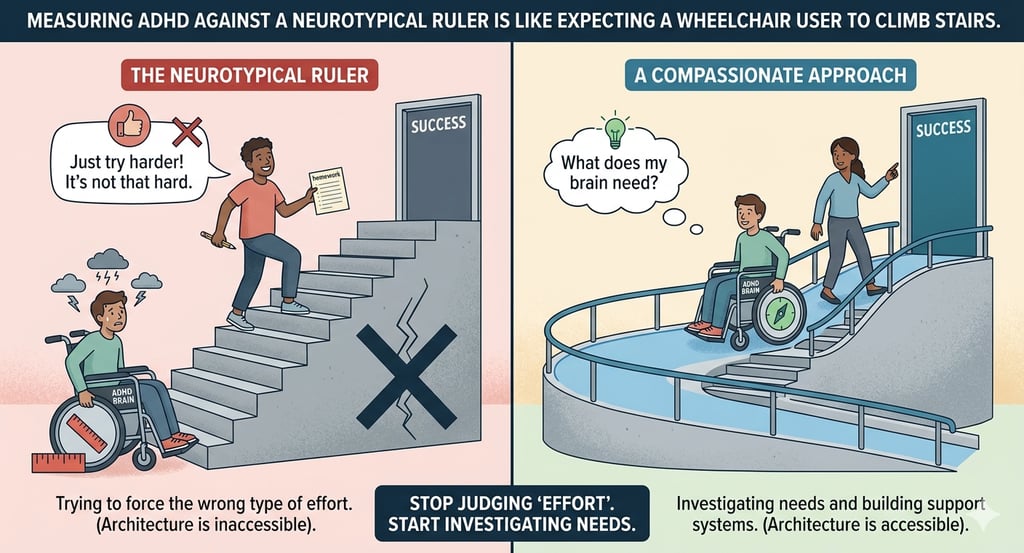
This image contrasts two approaches to ADHD support:
The Neurotypical Ruler represents judging ADHD brains by standards designed for non-ADHD brains. Telling someone with ADHD to “just try harder” is like expecting a wheelchair user to climb stairs—the architecture (expectations, environment, instructions) is inaccessible, not the person’s effort.
A Compassionate Approach shifts from judging effort to investigating needs. Instead of asking “Why aren’t you trying?” we ask “What does your brain need right now?” and build supports accordingly.
If You Are Neurodivergent (Lived Experience)
You are not broken. Difficulty with tasks others find “simple” is not a moral failure or lack of willpower.
When struggling, try replacing “Why can’t I just do this?” with “What does my brain need right now?” (e.g., a body double, movement break, external timer, rewritten instructions).
Self-compassion isn’t excusing yourself—it’s removing the stairs and adding a ramp so you can actually move forward.
Parents & Supporters (How to Help)
Stop measuring progress with a neurotypical ruler. Visible effort in ADHD often looks different: fidgeting, delayed starts, needing to talk through a task.
Instead of “You’re not trying hard enough,” ask: “What’s getting in the way?” (e.g., transition difficulty, sensory overload, working memory limits).
Build ramps: chunk instructions, use visual timers, reduce clutter, allow movement, and separate skill from will. Most struggles are not defiance—they’re inaccessible demands.
Clinicians & Educators
Replace “effort judgment” with needs assessment. If a student/patient repeatedly fails despite trying, the environment or task design is likely inaccessible—not the person.
Ask explicitly: “What would make this task feel possible for your brain?” Test accommodations like extended time, reduced distraction, written + verbal instructions, or frequent movement.
Document access needs, not character flaws. Avoid notes like “poor motivation.” Instead: “Requires task breakdown and immediate feedback to sustain engagement.” That’s the ramp—not lowering standards, just removing stairs.
Bottom line: The goal isn’t to climb stairs the neurotypical way. The goal is to build a ramp and reach the same destination—with dignity, not shame.
A word before you go...
This article is written for awareness and reflection, not as a clinical or medical resource. The visual explanations here are a simplified illustration of common patterns — individual experiences vary and may look quite different from what's described here.
This content is not a diagnostic tool and is not a substitute for professional support. If you're exploring questions around ADHD, emotional regulation, or neurodivergence, we encourage you to connect with a qualified mental health or healthcare professional who can speak to your specific situation.
Explore
⚠️ Educational notice: Learning how your brain works can support self-understanding, reduce shame, and help you advocate for your needs. Educational resources do not replace individualized professional support. For many people, education, therapy, coaching, medication, accommodations, and community support work together. Read the educational disclaimer.
Terms of Use
© 2026 AUplusDHD , a project of TNAZ Designs & Services, LLC. All rights reserved.
Support
Legal