Is a Cat a Broken Dog ?
Tahirat N.
3/7/20263 min read
A brief note...
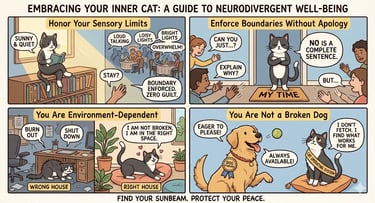
This article uses a simple analogy comparing common generalizations about dogs and cats to explore different ways our brains can work.
We want to be clear: this is not a statement about the actual value of dogs or cats. Dogs can be deeply sensitive and selective about their people. Cats can be incredibly social and adaptable. The goal here is not to rank or define animals, but to use familiar ideas to shed light on the neurodivergent experience.
If this analogy resonates with you, wonderful. If it doesn’t fit perfectly, that’s okay too. Take what works for you and leave the rest.
Explanation
The Problem
Why do so many neurodivergent people feel broken?
Because society uses ONE standard for "healthy" nervous systems:
Always available
Flexible with change
Tolerant of stimulation
Social on command
Let’s call this ... The Dog Standard
The "Dog Standard": Society’s Ideal
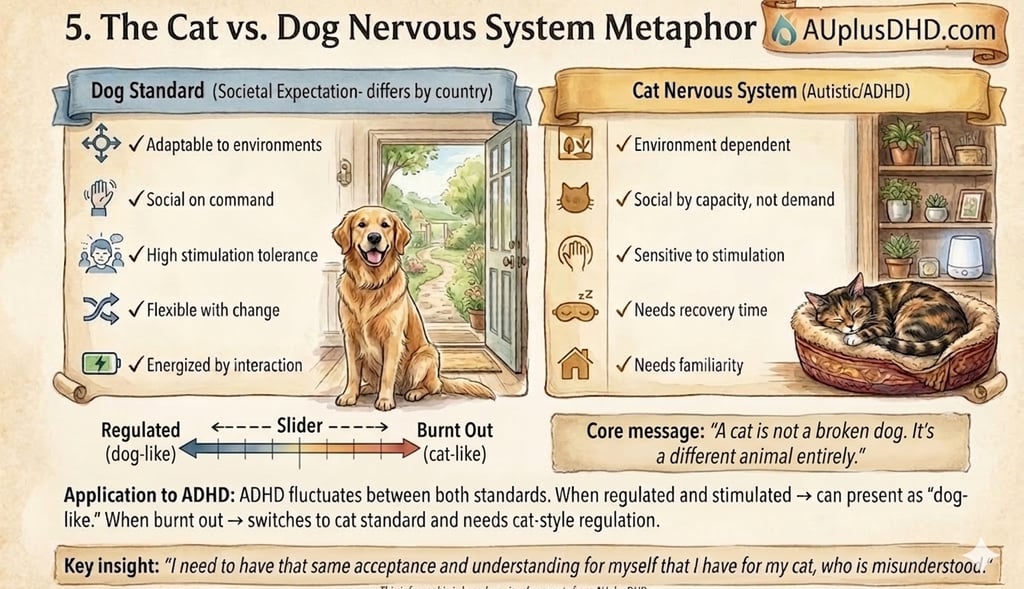
In many societies, the "Dog Standard" is favored. One is expected to be eager to please, adaptable to any environment, and always ready for social interaction.
As the images illustrate, the "dog" is expected to:
Adapt to any environment.
Be social on command.
Tolerate high levels of stimulation.
Be flexible with change.
Feel energized by interaction.
This is the standard against which many are measured. If they can’t do these things effortlessly, the implication is that something is wrong with you.
The "Cat Nervous System": A Different Operating System
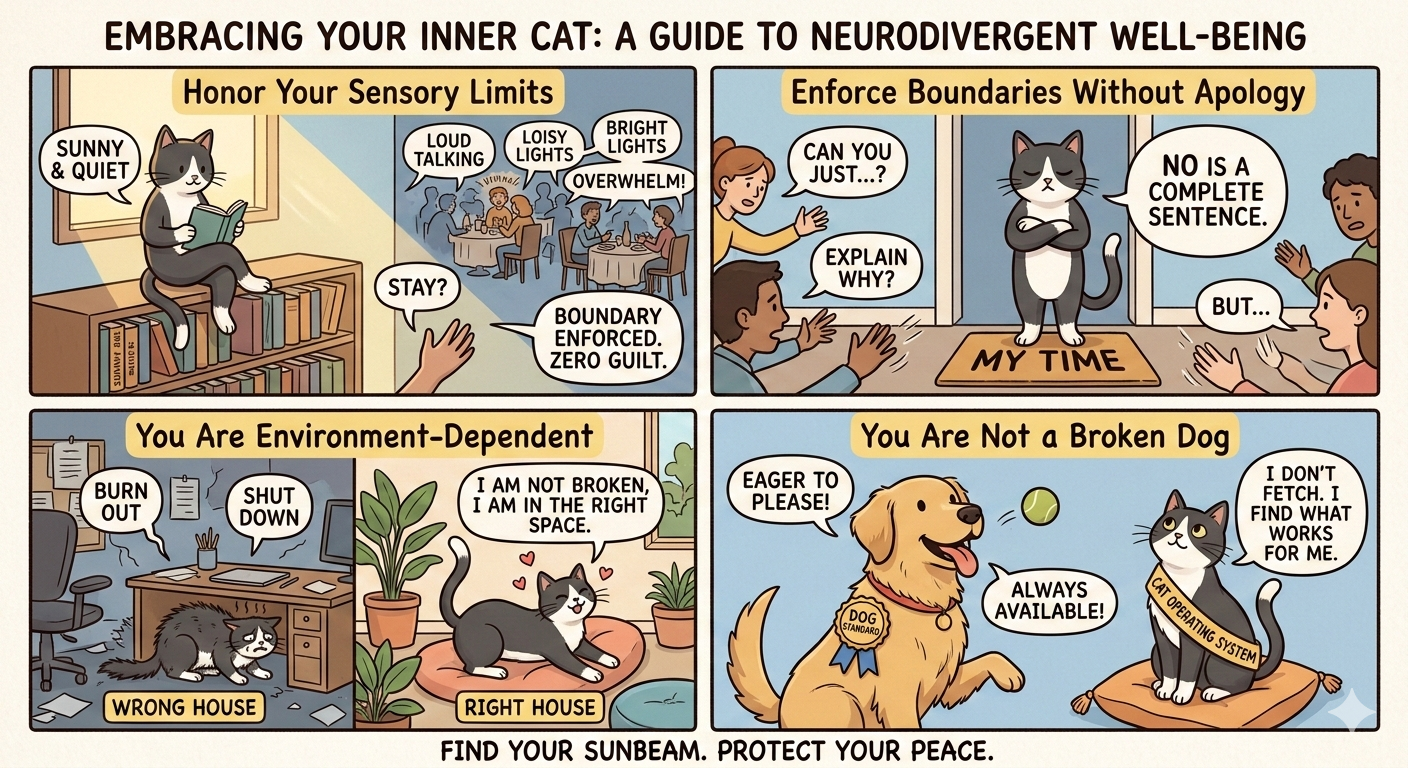
Now, let’s consider the cat. A cat operates on an entirely different system. It isn’t trying to be a dog and failing; it’s simply being itself. Its needs and boundaries are clear, and it enforces them without apology.
For many neurodivergent people, the "Cat Nervous System" is a far more accurate description. This system is characterized by:
Environment-Dependence: A cat knows that its well-being is directly tied to its surroundings. In the "wrong house"—a chaotic, loud, or unpredictable environment—a cat may hide, become agitated, or "shut down." But in the "right house"—a calm, predictable space with cozy spots and quiet—it thrives. Burnout and shutdown aren't signs of brokenness; they are signs of being in the wrong environment.
Sensory Sensitivity: Cats have clear sensory limits. They are easily overstimulated by loud noises, bright lights, or too much handling. When they’ve had enough, they take action. They don’t push through the discomfort to please anyone; they simply disengage and find a quiet, sunny spot to recover.
Boundaries Without Guilt: A cat does not apologize for protecting its nervous system. It doesn’t fetch just because you want it to. It doesn’t feel guilty for saying "no" by walking away. For a neurodivergent person, this is a powerful lesson: "No" is a complete sentence. You do not have to explain, justify, or people-please at the expense of your own well-being.
The Core Message
"A cat is not a broken dog. It's a different animal entirely."
You cannot shame a cat into being a dog.
You cannot willpower your way into a different nervous system.
The ADHD Twist
ADHDers can switch between Dog and Cat mode
When...Stimulated, interested, dopamine flowing nervous system switches to... dog mode (energized, social, flexible).
When...Burnt out, overwhelmed, understimulated nervous system switches to... cat mode (needs space, routine, recovery).
Neither mode is fake. Both are real. Both need different accommodations.
Permission Slips (Affirmations)
Read these aloud when guilt shows up:
"I'm a cat. I don't perform on demand."
"A cat isn't a broken dog. I'm not broken."
"My nervous system is protecting me, not failing me."
"Cats don't apologize for needing space. Neither do I."
"Recovery isn't laziness. It's regulation."
The Name-It-to-Tame-It Rule
Whenever you're stuck on something you WANT to do but CAN'T do:
Name it – Is this my ADHD? My autism? Both? PDA?
Don't shame it – This is not a character flaw
Accommodate it – What does my cat (or dog) nervous system need right now?
"If I want to do something but I can't get myself to do it, it's not willpower. It's my nervous system."
A word before you go...
This article is written for awareness and reflection, not as a clinical or medical resource. The visual explanations here are a simplified illustration of common patterns — individual experiences vary and may look quite different from what's described here.
This content is not a diagnostic tool and is not a substitute for professional support. If you're exploring questions around ADHD, emotional regulation, or neurodivergence, we encourage you to connect with a qualified mental health or healthcare professional who can speak to your specific situation.
Explore
⚠️ Educational notice: Learning how your brain works can support self-understanding, reduce shame, and help you advocate for your needs. Educational resources do not replace individualized professional support. For many people, education, therapy, coaching, medication, accommodations, and community support work together. Read the educational disclaimer.
Terms of Use
© 2026 AUplusDHD , a project of TNAZ Designs & Services, LLC. All rights reserved.
Support
Legal