Can a Fish Be Expected To Climb a Tree?
Tahirat Nasiru (LCSW)
3/8/202611 min read
Ability is contextual: stop expecting a fish to climb a tree
Traditional checklists, diagnoses, and clinical language often describe behavior from the outside in. They measure ability by neurotypical compliance metrics such as staying still, being on time, and conforming to expectations.
That is like judging a fish by its ability to climb a tree and then telling the fish that something is wrong with it when it cannot.
But what if the problem was never the fish? What if the problem was the measuring stick?
Here is the truth: ability is contextual, and the right standards matter.
Take ADHD as an example. It is often labeled an "attention deficit disorder." That label compares the ADHD neurotype to a neurotypical standard of focus. But a deeper look reveals something different: ADHD is not a deficit of focus. Rather, it is a challenge with focus regulation that is made worse by environments not designed for how this neurotype actually works.
In other words, the ADHD mind CAN focus, and it DOES focus very well, when the RIGHT CONDITIONS are met—conditions that account for how the ADHD mind actually works.
So if we truly want to create systems that work and standards that are appropriately aligned, we must capture the inner experience in order to understand the outer behavior.
At AUplusDHD (AU+DHD), we believe that neurodivergent minds are not broken versions of neurotypical minds. They are not deficits to be fixed. They are a different neurological operating system.
The Tree: When One Standard Fits All
So what does the tree represent?
In short: any system, environment, or expectation designed around a neurotypical nervous system, then applied to everyone as if it were neutral.
Standards aren't bad. But the problem begins when we treat the tree as the universal measure of ability. When we look at every individual and say, "Can you climb this? If not, you're failing."
What does that look like in real life?
A school system built on sitting still, working in silence, and processing information at a standardized pace.
A workplace requiring rigid nine-to-five hours, open-plan offices, and back-to-back social interactions.
Social expectations forcing eye contact, quick responses, quiet emotional management, and never needing more time or space than anyone else.
Assessment systems that measure intelligence in one or two narrow ways.
And the unspoken rule: if you struggle, the problem is your effort—not the environment's design.
The tree is the default. The assumption that the way things have always been structured is the correct and only way.
What does 'ability is contextual' mean?
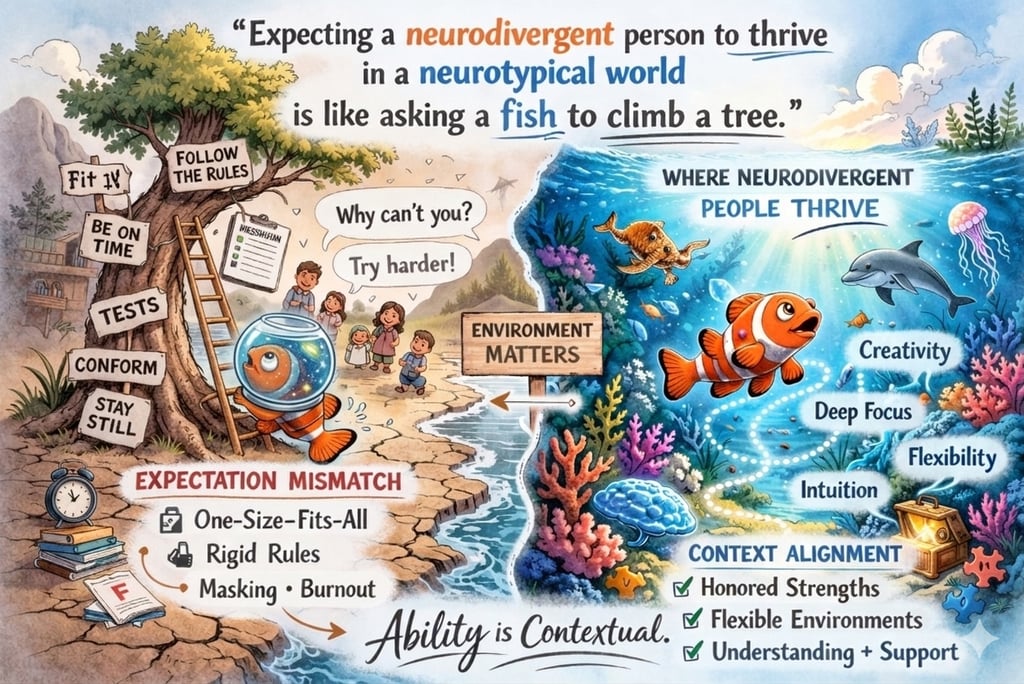
In the image, the fish is also shown in the ocean. No fishbowl. No ladder. Just water.
The ocean represents an environment suited for his neurotype. And in that environment, his ability shines.
This is the critical point: ability is contextual.
Take an ADHD child in a traditional classroom. Expected to sit still for hours. No stimming. No sensory tools. The subject isn't stimulating. That child may fail the class and be labeled as "failing." But what isn't captured? Their ability to hyperfocus on engaging projects—producing exceptional work.
It's not that the child can't focus. It's that his focus is regulated differently, and the classroom doesn't allow for that regulation. The child needs our help to find their ocean, where he performs at optimal capacity. The potential was never missing. It was inaccessible in the wrong environment.
The Ladder: An Accommodation That Isn't Enough
Notice the ladder. It makes things easier, but not ideal. And look closer: the fish in the image has somehow developed fingers. Not fins. Fingers.
What does this tell us? Despite the challenge of climbing trees, many neurodivergent individuals find ways, often painstakingly, to perform at the level of or above the standard-- that is resilience and a testament of the strength of their neurotype.
We are all environment dependent
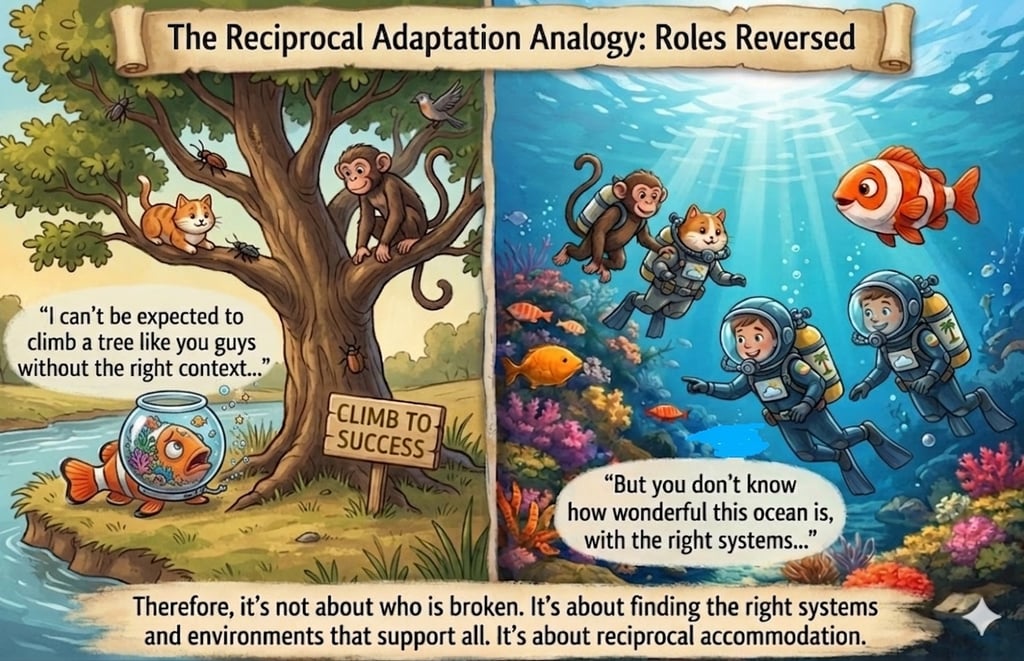
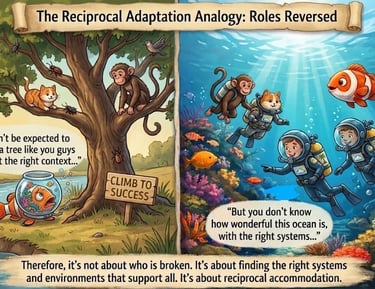
And this is true for neurotypical people too. Put a land-dweller in the water. Suddenly they need oxygen tanks and special suits. They can't swim like the fish. That doesn't make them broken, would it? It makes them mismatched.
We are all environment-dependent. Every living thing on Earth — from a redwood to a beetle to you — exists because the conditions here happen to suit it.
Change the conditions, and life changes too.
The question isn't "who is broken?" It's "what environment allows this person to thrive?"
The Fishbowl: Hidden Labor, Constant Survival
Now let's talk about the fishbowl.
The fishbowl represents the neurodivergent person carrying their own environment within them because the world around them doesn't provide it. He's on dry, cracked land. The sun is hot. His scales aren't built for this. But he has managed to keep a small amount of water around himself by wearing his own bowl.
What does that look like in real life?
A person who does exhaustive research before every social situation because unpredictability is dysregulating, and no one around them accounts for that.
A person who builds elaborate systems, reminders, and routines just to function at the level everyone else reaches automatically.
A person who scripts conversations in advance, rehearses interactions, and decompresses for hours after a social event because connection doesn't come with a built-in filter.
Someone who wears noise-canceling headphones everywhere, keeps sunglasses in every bag, always knows where the exit is—because they've learned to manage their own sensory environment since the world won't do it for them.
A person who has spent years learning to appear okay—masking, performing, compensating—so that people around them don't see the enormous effort it takes just to be present.
Here's the thing no one talks about: the fishbowl strategy works up to a point. That's why it's so invisible. From the outside, the fish looks like he's managing. Upright. Moving. Hasn't collapsed.
But what you can't see is how much cognitive and emotional energy goes into managing that bowl every single day. How much of his capacity is consumed just by keeping enough water around himself to stay functional—water that should be freely available in the environment, but isn't.
This is why neurodivergent people often describe a depletion that doesn't make sense to others. From the outside: "You seemed fine today." From the inside: "I just spent everything I had to get through that day."
The bowl is hidden labor. Constant self-management. Coping strategies that look like capability but are actually survival.
And here's an important distinction: the fishbowl isn't a solution. It's a workaround. A brilliant, resourceful, hard-won workaround. We're not diminishing its importance. But no matter how good you are at carrying your fishbowl, you are still operating in an environment that is deeply stressful to your nervous system.
The fishbowl keeps you alive. The ocean helps you thrive.
The Ocean: What Thriving Actually Looks Like
The ocean represents any environment designed or adapted to match how a neurodivergent nervous system actually works—rather than demanding the nervous system change to fit the environment.
The ocean isn't charity. It isn't lowering the bar. It's offering the right conditions for that person to function at full capacity.
In real life, the ocean looks like this:
In a classroom: movement, fidget tools, flexible seating, multiple ways to demonstrate understanding.
In a workplace: flexible hours, remote or low-sensory options, written instructions, permission to work in ways that produce results—and managers with listening skills, empathy, and the ability to support individual needs.
In relationships: meeting your partner in a way that lets them not always mask their communication style—aiming for a balanced effort, meeting sensory and emotional needs with curiosity instead of correction.
In therapy: a space where the goal isn't compliance with neurotypical expectations, but genuine understanding of how your client's nervous system works—adapting your modality to fit that nervous system.
In daily routines: schedules built around actual energy patterns, regulation needs, and natural strengths, rather than a one-size-fits-all template.
The ocean doesn't create the fish's ability. The creativity, deep focus, flexibility, and intuition were always there. The ocean simply creates the conditions for those attributes to emerge.
For many neurodivergent people, finding their ocean—whether it's a person, a job, a space, a community, or even a single relationship where they don't have to perform—is genuinely life-changing. Not because anything about them changed, but because for the first time, they get to find out what they're actually capable of when they're not spending all their energy trying to breathe on land.
The Damage of Expectation Mismatch
When a fish can't climb the tree—even with his ladder—we must not perceive him as lazy or not trying hard enough. Unfortunately, this shame-based narrative is what many neurodivergent people experience.
Many neurodivergent individuals carry internal shame, pain, doubt. An internal story of "I am broken. I need to try harder. Why can't I just do what everyone else does?"
This expectation mismatch leaves behind deep psychological distress.
What You Can Do: A Note for Supporters, Educators, and Employers
If you're not neurodivergent, or you're a supporter, when the thought comes—"Why can't they just…"—pause.
Instead, ask:
What environment does this person actually need to function well?
What am I expecting that might be the wrong tree entirely?
If you work in education, healthcare, or any system that touches neurodivergent minds: understand that one size does not fit all. That is not a neutral stance. It actively disables people whose nervous systems work differently. And it means you're not tapping into the highest potential of your workforce or your agency.
Investing in systems that allow everyone to excel isn't just ethical. It's a win-win.
You don't need to know everything about neurodivergence to support someone. Start with questions: "Does this work? What works best for you? How can I help?" Be inquisitive and curious. Especially when your interventions repeatedly fail—it's time to change perspective.
Final Thoughts: The Bowl Cracks
The fishbowl works until it doesn't.
And that leads us to the conversation about masking and burnout—what happens when the gap between the environment's demands and the nervous system's actual capacity becomes too wide to bridge. When the fish has been carrying that bowl for so long that the effort of just surviving has consumed every resource.
But recovery isn't about rebuilding the capacity to mask again. It's about gradually and meaningfully reducing the distance between who you actually are and what your environment asks you to perform.
Ask yourself: What would it look like to need my bowl a little less today?
Maybe that's one conversation where you don't have to perform eye contact. One environment where sensory input is manageable. One person who already knows how your nervous system works and doesn't need you to explain or justify yourself.
Small pieces of an ocean.
We may not be able to bring the entire ocean to a neurodivergent person yet. Society has a long way to go. But we can bring pieces of it. And that is where recovery starts.
The fish was never meant to climb the tree. But in the right water, you'd be amazed at what he can do.
"The world is full of trees. But it's also full of oceans, lakes, rivers, streams. We don't all need to be in the same place. We just need to be in places where we can swim."
- Tahirat Nasiru. LCSW
Where Neurodivergent People Thrive
Autism
Think of an autistic mind as a coral reef. Incredible pattern recognition. Deep focus. Honesty that cuts through social noise. The ability to notice what everyone else somehow missed.
But here's where environment matters.
Thrives in: Clear communication. Directness—not as a preference but as a lifeline. Written instructions instead of reading between the lines. Quiet workspaces without fluorescent buzzing. Time to process. Projects that reward depth over speed. Colleagues who say what they mean and mean what they say.
Does not thrive in: Open-plan offices with constant interruption. Unwritten social rules you're just supposed to know. Performance reviews that punish not-enough-eye-contact. Sarcasm as management style. Meetings where the actual decision happened in the hallway before anyone sat down. "We've always done it this way."
An autistic person isn't broken when they melt down from overstimulation. They're coral pulled from the reef.
ADHD
Alright. ADHD brain. Here's what people don't see.
This mind doesn't have a deficit of attention—it has too much attention. Just not always on what you'd like it to be on. It's scanning. Constantly. Looking for what's novel, urgent, interesting, or alive. That's why boring things are genuinely painful. It's not laziness. It's biochemistry.
Thrives in: Fast-paced environments where new problems arrive constantly. Creative sprints with tight deadlines. Physical movement while thinking (yes, pacing helps). Body doubling—working next to someone else who's also working. Passion-driven projects. Multiple overlapping interests. Systems that externalize memory—lists, alarms, sticky notes everywhere.
Does not thrive in: Long meetings with no agenda. Repetitive data entry. Performance based on how well you look like you're working. Shame as motivation. "Just sit still and focus." Projects that take six months with no intermediate dopamine hits. Performance reviews that call you "lazy" or "flighty" without understanding the engine under the hood.
An ADHD person isn't failing because they forgot the email. They're phytoplankton in polluted water. The environment is asking them to do the one thing their brain is structurally not built to do.
AuDHD (Autism + ADHD)
Here's where it gets really interesting. And really lonely sometimes.
AuDHD is both. The autistic need for routine, predictability, deep focus. And the ADHD need for novelty, stimulation, movement. At the same time. Inside one brain.
Sound exhausting? It is.
Thrives in: Structures that have flexible consistency. Same framework, different content. Projects that allow deep dive hyperfocus and quick switching when needed. People who understand that some days you need total quiet and same-food-for-dinner, and other days you need to drive a different route just to feel awake. Accommodations that don't ask you to pick one "real" self.
Does not thrive in: "Pick a lane" culture. Jobs that demand either rigid sameness or constant chaos. People who say "but you were fine yesterday" when today is different. Environments that punish both routine-seeking and novelty-seeking. Having to mask both sides at once—pretending to be calm when you're understimulated and pretending to be engaged when you're overwhelmed.
An AuDHD person isn't confused about who they are. They're a coral reef with unpredictable currents. The environment either lets both sides exist—or neither does.
What do all three have in common?
Their survival—their ability to contribute—depends entirely on the environment around them. Not their effort. Not their willpower. Not how hard they try to be different.
When the environment fits, you don't notice anything special. The autistic person catches the error no one saw. The ADHD brain connects two unrelated ideas and solves a problem in ten seconds. The AuDHD person brings structure and creativity, sometimes in the same breath.
When the environment doesn't fit? They don't struggle because they're weak. They struggle because they're fish being asked to climb.
And the loss isn't theirs alone. It's all of ours.
Interactive Deep Dive: How you can support them
Where you are an educator, parent, employer, friend, our interactive guide provides easy practical steps you can take today. Remember, you don’t need to understand everything. You just need to understand them a little more than you did yesterday.

Disclaimer
This article is written for awareness and reflection, not as a clinical or medical resource. Individual experiences vary widely. If you're exploring questions around neurodivergence, please connect with a qualified professional who can speak to your specific situation.
Explore
⚠️ Educational notice: Learning how your brain works can support self-understanding, reduce shame, and help you advocate for your needs. Educational resources do not replace individualized professional support. For many people, education, therapy, coaching, medication, accommodations, and community support work together. Read the educational disclaimer.
Terms of Use
© 2026 AUplusDHD , a project of TNAZ Designs & Services, LLC. All rights reserved.
Support
Legal