ADHD Mental Tabs: Why Can't I Focus?
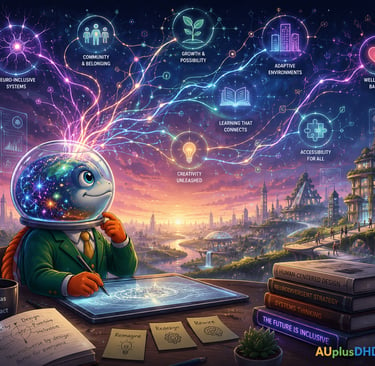
Visual Explainer Card: Understanding ADHD Focus From Inside The Headspace
These are common patterns, not universal rules. Individual experiences vary.
CLICK HERE TO EXPERIENCE THE MENTAL TABS INTERACTIVE MODULE
Take your time to look at this image and reflect on what it may mean before expanding the answers.
🧠 Understanding ADHD Thought Patterns
For many neurotypical minds:
Thoughts follows one after another like trains on a track. Although there may be some occasional pop up thoughts ( intrusive thoughts), neurotypical thought streams generally follow a linear process A--> B---> C.
However the ADHD brain.
Is like a web browser where:
🟦 There is a foreground tab (the task in front of them).
🟨 There are multiple background tabs (parallel thoughts running at the same time).
🟥 There are pop-up windows (intrusive thoughts, reminders, random ideas).
And here’s the key:
The browser NEVER fully closes; It’s always active. All tabs are competing to become the MAIN tab.
What This Feels Like
Even when someone with ADHD is sitting quietly, their mind is often:
🖥️Running simulations;
🔊Noticing sounds;
⏳Thinking about future tasks;
🗣️Replaying conversations;
💡Generating new ideas.
When an ADHD brain is under-stimulated ( aka the task is boring):
Background mental “tabs” multiply; Pop-up thoughts increase; The brain looks for dopamine to stabilize attention.
Therefore...
"Impulsive actions are often not about recklessness. They’re attempts at regulation"
( A Common Misconception).
Alternative metaphors
Other Metaphors used by the ADHD communities
The Two Track Mind
The Two-Track Mind: If Track 1 is for work, an under-stimulated Track 2 gets bored and seeks trouble. Giving Track 2 a "toy"—like music or a fidget—allows Track 1 to proceed uninterrupted.
The Three-Channel Radio or Parallel Thinking
The Simple Version: Imagine your mind is a radio playing three stations at once:
Station 1 (Foreground): The thing you are trying to do right now.
Station 2 (Background): Constant mental chatter, songs on loop, or "to-do" lists.
Station 3 (Pop-ups): Sudden intrusive thoughts or "what-if" worries.
When you are under-stimulated, Stations 2 and 3 get louder than Station 1, making it nearly impossible to stay on track.
Want to see it in action?
CLICK HERE TO EXPERIENCE THE MENTAL TABS INTERACTIVE MODULE
How to Minimize the Tabs:
The key is to minimize the tabs using "sensory chew toys"....
Unlike a computer browser whose tabs can be closed, the ADHD mental tabs ( background and pop ups) can’t simply be shut down.
So instead of forcing silence, a helpful strategy is to “minimize” the extra tabs by giving the background tabs a small, controlled source of stimulation — a “sensory chew toy.”
Examples include:
🎲Using a fidget spinner
🎵Playing low, non-mentally competing background music
🚶➡️Walking on a treadmill while working.
These activities lightly engage the restless parts of the brain, making it easier for the main task to stay in focus.
In other words: The goal isn’t to eliminate stimulation or 'distractions'—it’s to manage it strategically so focus becomes possible.
Effective ' Sensory Chew Toys'
How to select a 'chew toy' for the background tabs
The best background tab "chew toys" are the ones that follows the "2 Sense Rule".
The rule states:
"For effective parallel processing, your primary task and your background stimulation should primarily engage different senses and cognitive systems."
The Goal: To feed your brain's need for extra stimulation (the "second track") without creating direct competition for the specific neural resources your main task requires.
How to Apply the Rule
Choose a background activity that is:
Sensory-Distinct: Uses a different primary sense (e.g., auditory vs. visual, tactile vs. auditory).
Cognitively-Simple: Is repetitive, predictable, low-stakes, or non-linguistic, so it doesn't demand deep executive function.
Examples:
Music (Auditory/Emotional) + Reading (Visual/Language): They use distinct processing pathways.
TV (Passive Visual/Auditory) + Laundry (Kinesthetic/Motor): The manual task runs on muscle memory.
Fidgeting (Tactile) + Listening (Auditory): Rhythmic movement provides a steadying beat that anchors attention.
Most people think of ADHD as just being "distracted," but the reality is often the opposite: we get too focused. Think of my brain like a web browser. Usually, my attention is bouncing between dozens of open tabs because I'm under-stimulated.
But when I find something highly stimulating, my brain doesn't just "focus"—it locks on. This is negative hyperfocus, and it comes with a heavy "tax" that I pay in three specific ways:
1. The Physical Tax
When I’m in a "stuck state," my brain ignores my body’s basic signals.
Impact: I might experience severe dehydration or eye strain.
Impact: I often forget to eat or handle basic physical obligations.
The Reality: I'm not "choosing" the rabbit hole over my health; my brain has temporarily lost the ability to "click away".
2. The Social Tax
This is often the hardest part for others to understand.
Impact: I might forget to text someone back or completely lose track of time.
Impact: It causes me to be late to events because I was "stuck" on a stimulating topic.
The Reality: It isn't a lack of care for the other person; it's a breakdown in Task Switching—the mental muscle required to move from one activity to another.
3. The Mental Tax
Even when the "stuck" state ends, the tax continues.
Impact: There is an overwhelming sense of guilt and shame that comes afterward.
Impact: I feel a deep frustration when I realize I "wasted" time on something unhelpful while important tasks went unfinished.
The Reality: This mental fatigue makes it even harder to start the next task, creating a cycle of exhaustion.
The Bottom Line: If you see me stuck in a rabbit hole, please understand that I’m not being "lazy" or "ignoring" the world. I’m currently paying a tax I never signed up for.
Support Cheat Sheet: When My Brain Gets "Stuck"
1. How to Spot the "Rabbit Hole"
I am likely in a negative hyperfocus (the "Stuck" state) if:
The Glaze: I’m staring at a screen/task with an intense, unblinking focus.
The Silence: I haven't moved, eaten, or checked my phone in hours.
The Defensive Snap: I get irrationally frustrated if you ask me a simple question (this is my brain struggling to "task switch").
2. Your Role: The "External Brake"
When I’m in this state, my internal "off-switch" is broken. Your goal isn't to judge the topic, but to help me regulate my energy before I pay the ADHD Tax.
3. The "Pattern Interrupt" Menu
Choose the level of intervention based on how "stuck" I am:
Level 1: The Gentle Check-in
"Hey, how's your 'mental battery' doing?"
"Do you need a quick browser refresh? I have a glass of water for you."
Level 2: The "Bridge" Strategy
"I see you're deep in that project. In 15 minutes, let's close the laptop and [Specific Next Activity]."
"I’m leaving [Object] here as a physical reminder for when you're ready to switch."
Level 3: The Hard Stop (Late Night/High Tax)
"The ADHD Tax is getting high. Let's 'save this tab' for tomorrow morning."
"I’m going to stand here until you look at me so we can break the spell together."
4. Reminder: Why We Are Stopping
If I struggle to let go, gently remind me of the "Tax" I’m about to pay:
Physical: "You’re going to have a 'focus hangover' tomorrow if you don't sleep."
Social/Mental: "I want to help you avoid the guilt of losing this time."
The "Bridge" Menu (Choose one to help me transition)
When you use the "Safe Word" to interrupt my hyperfocus, please help me use one of these bridges to soften the landing:
The Sensory Reset (High Priority): * The Action: Hand me a glass of cold water or a strong-flavored snack (sour, spicy, or minty).
Why it works: It forces my brain to register my physical body and breaks the mental loop of the "stuck" tab.
The "Save for Later" Ritual: * The Action: Hand me a sticky note and a pen. Tell me: "Write down the very next step for this project so you don't lose it, then we're closing the tab".
Why it works: It lowers the anxiety of "losing the spark" and gives my brain permission to disengage safely.
The Audio Pivot: * The Action: Ask me what podcast or music I want to listen to while we do the next task (like dishes or getting ready for bed).
Why it works: It provides a "middle-ground" level of stimulation. It carries my dopamine levels from the "interesting" thing to the "necessary" thing.
Note to Supporter: Moving from a "Focused State" to a "Low Stimulation" state can feel like a crash. These bridges are the "landing gear" that prevent me from feeling overwhelmed or frustrated during the switch.
Our "Safe Word" Agreement
When you use our safe word ([Insert Word Here]), I agree to:
Stop what I am doing immediately (even if it feels physically painful).
Take three deep breaths to reset.
Listen to your suggestion for a transition.
Note to Supporter: I give you full permission to interrupt me. You aren't being "bossy"—you're helping me manage a brain that sometimes forgets how to manage itself.
Want them to see it in action?
CLICK HERE TO SHARE THE MENTAL TABS INTERACTIVE MODULE
“A helpful way to understand ADHD attention is through a browser-tab metaphor.
In the unfocused state, the ADHD brain holds multiple mental ‘tabs’ open simultaneously.
Each tab represents a thought stream, task, memory, or sensory input competing for attention.
This reflects parallel processing — a cognitive style in which the brain processes multiple streams of information at the same time, rather than completing tasks sequentially.
In contrast to serial processing (one task, then the next),
parallel processing distributes attention across several active channels simultaneously.
This explains why ADHD is often misinterpreted as distractibility or lack of effort.
The issue is not insufficient attention, but how attention is allocated.
Traditional advice like ‘just focus on one thing’ asks a parallel processor to behave like a single-threaded system — a mismatch in expectations.
When interest, novelty, or relevance is present, the system reorganizes.
The tabs do not close — they cluster.
In the focused state, multiple cognitive streams align around a shared topic or goal.
Attention becomes integrated rather than divided, allowing for sustained, deep engagement.
Clinically, this reframes ADHD focus as an issue of alignment rather than control.
The therapeutic task is not to reduce cognitive activity,
but to help clients identify conditions that allow their parallel processes to converge.
When this occurs, the ADHD brain often demonstrates exceptional creativity, insight, and persistence.”
INTERESTED IN LEARNING MORE?
CLICK HERE for more details on this topic and to try the ADHD mental tabs simulation OR
Check out our clinician page for more resources/information
Share it — send it to someone who needs to understand you, without having to find the words yourself
Use it in conversation — open it together and say "this is what happens for me"
Use it in session — clinicians: introduce before or during psychoeducation discussion
Print it — stick it somewhere visible as a reminder
Use it as a starting point — you don't have to explain everything, just say "read this first"