The Sprinter and the Browser: Understanding How the ADHD Mind Really Works
A plain-language guide for anyone who wants to understand the ADHD mind
Tahirat N., LCSW
2/23/20265 min read

Greetings 👋🏽
Most conversations about ADHD focus on what's wrong. The missed deadlines, the forgotten appointments, the half-finished projects gathering dust. But these behaviours aren't signs of laziness or lack of effort. They are symptoms of a brain that is simply built differently — a brain that runs on an entirely different mental architecture than the one our schools, workplaces, and daily routines were designed for.
This article is about explaining that difference. Not to excuse, but to illuminate.
Metaphor #1: The Sprinter vs. The Marathon Runner
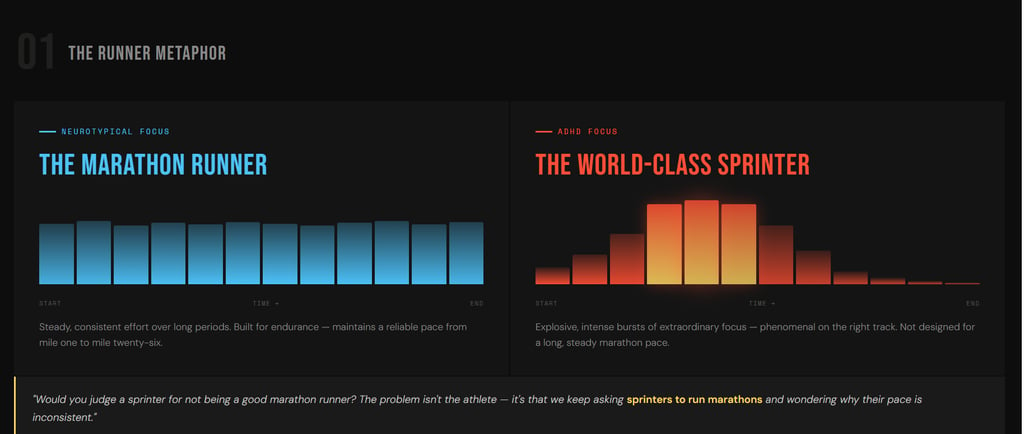
Imagine asking a world-class sprinter to run a 26.2-mile marathon. They might start strong — impressively so. But their body, engineered for short explosive bursts of maximum power, would quickly struggle. Their pace would falter. The crowd would be confused. The athlete themselves might feel a deep, bewildering sense of failure.
Would you blame the sprinter for not being a good marathon runner? Of course not.
And yet, this is precisely what we ask of people with ADHD every single day.
The Neurotypical Mind: Built for the Marathon
The neurotypical focus system operates like a gifted marathon runner. It is built for sustained, steady effort. It can maintain a consistent pace over long periods without burning out. Tasks that require plugging away for hours — writing reports, attending long meetings, completing routine administrative work — are the marathon. And the neurotypical brain handles them with relative ease.
The ADHD Mind: Built for the Sprint
The ADHD focus system is something else entirely. It is explosive, powerful, and under the right conditions, phenomenally intense. When an ADHD brain is engaged — truly engaged — it doesn't just focus. It locks in with a laser precision that can be astonishing to witness.
But it wasn't built to sustain a slow, steady marathon pace. Asking an ADHD brain to maintain consistent, moderate effort on a routine task for hours is like putting a sprinter in lane one of a marathon and then wondering why they look miserable, distracted, and perpetually behind.
The problem isn't the athlete. The problem is that we keep asking sprinters to run marathons — and then diagnosing them with a running disorder.
Metaphor #2: The Train Station vs. The Browser
To understand why the sprinter and marathon runner think so differently, it helps to look at the underlying architecture of their minds.
The Neurotypical Mind: A Quiet Train Station
Picture a calm, orderly train station. Trains arrive one at a time. Each train gets your full attention as it pulls in. You deal with it, it departs, and the next one arrives. There are no simultaneous arrivals, no overlapping platforms, no background noise from a dozen other trains all clamouring for the same track.
This is how the neurotypical mind processes thoughts. One arrives, gets attended to, and moves on. The station remains calm. The process is linear, efficient, and doesn't create much mental clutter.
The ADHD Mind: A Browser with many Open Tabs
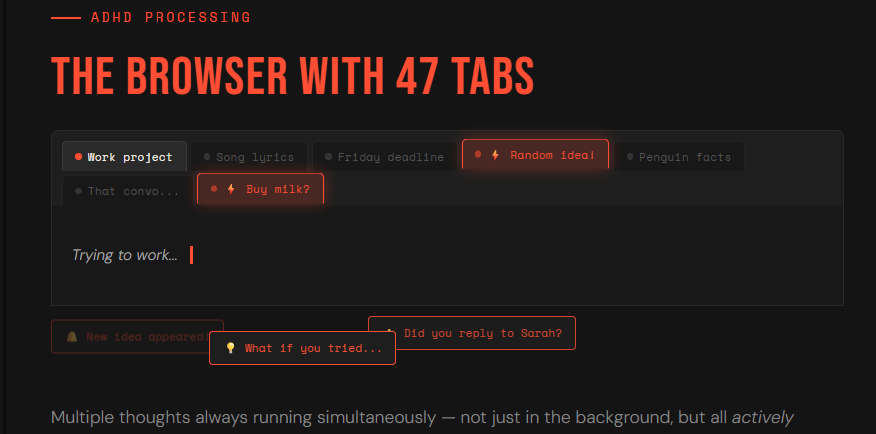
Now picture something very different. An internet browser — but with a completely different default setting. Not one tab. Not five. Dozens, constantly running.
🟦 A Foreground Tab: The task in front of them.
🟨 Multiple, Active Background Tabs: Parallel thoughts running simultaneously. (The lyrics to a song, a work project due Friday, a worry about a friend, a random fact about penguins).
🟥 Constant Pop-up Windows: Intrusive thoughts, sudden reminders, random ideas, external sounds.
The critical detail is this — the background tabs don't get closed. They get minimized. They are all actively running, all consuming mental energy, and all constantly competing to jump to the front and become the main screen.
It's not a quiet train station. It's a bustling control room with a dozen live feeds all fighting for the main screen — and no off switch.
This is why someone with ADHD can be sitting perfectly still while their mind is a whirlwind. They are running social simulations, noticing every ambient sound, planning tasks three steps ahead, replaying a conversation from two weeks ago, and generating ideas for a project they haven't started yet — all at once, all involuntarily.
When the task at hand is boring or under-stimulating, the background tabs multiply. The pop-ups become more frequent. The brain is desperately seeking stimulation to stabilize its attention. This is where so-called "impulsive actions" come from — grabbing a phone, starting a new project. Not recklessness. Self-regulation.
When the Sprinter Finds Their Track: The Flow State
Now for the part that changes everything.
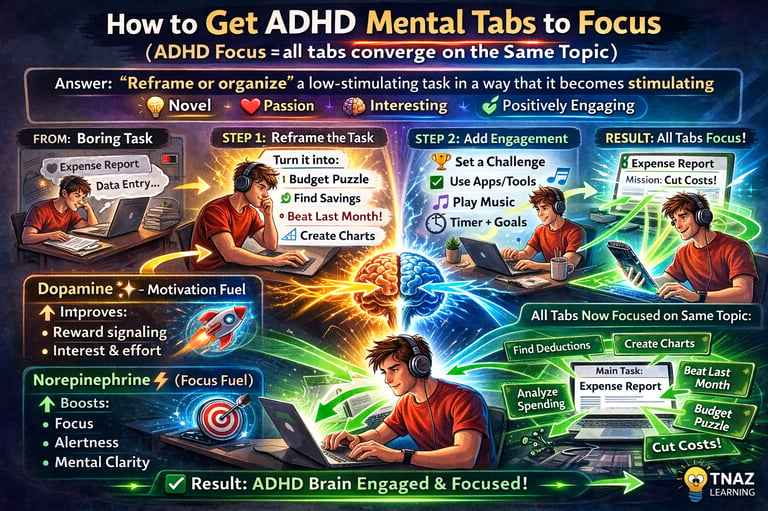
When the right subject appears — something novel, genuinely challenging, deeply interesting — something remarkable happens in the ADHD brain. All those scattered, competing background tabs don't disappear. They converge. They align themselves around the one interesting topic, and suddenly all that parallel processing stops fighting and starts collaborating. Creativity, problem-solving, memory, pattern recognition — all firing together in perfect harmony.
This is the sprinter, perfectly trained, exploding off the blocks on exactly the right track.
In this state — often called hyperfocus — an ADHD brain is a high-performance engine. It can outperform almost anyone on bursts of creativity, rapid innovation, and intense problem-solving. People with ADHD often describe it as the only time their mind feels truly quiet, because everything is finally pointed in the same direction.
There is, however, a shadow side. When a topic is too stimulating, the sprint doesn't end at the finish line. The mind gets locked in. The browser tabs have not only merged — they've locked the screen. You cannot switch away, even when you desperately need to.
This is where the "ADHD Tax" gets paid. The physical tax: you forget to eat, your eyes strain, you realise with a jolt you haven't moved for four hours. The social tax: missed texts, ignored calls, showing up late to dinner — not out of rudeness, but because time simply ceased to exist. And the mental tax: the heavy, crushing guilt when the spell finally breaks and you see how much real work was left undone.
What This Means for the People Around Them
Understanding this architecture doesn't excuse missed deadlines or social absences. But it does replace judgment with context — and context changes everything.
The fidgeting isn't rudeness. It's an attempt to generate enough sensory input to quiet the background tabs. The sudden new hobby isn't flakiness. It's a sprint-built brain searching desperately for the track it was designed to run on. The lost keys or missed appointment isn't carelessness — it's a mind that was four tabs deep in something else and never formed the memory in the first place. And the extraordinary output on the right project isn't a fluke. It's what happens when a high-performance engine finally gets the right fuel.
The real challenge of ADHD isn't focusing on something. It's regulating that focus — turning it on when needed and, crucially, turning it off. It's the difference between choosing to run a marathon and being a sprinter who can't stop running until they collapse.
A Different Kind of Support
The goal of understanding the ADHD mind isn't to lower expectations. It's to change how we offer support, how we design environments, and how we interpret behaviour that looks, from the outside, like wilful chaos.
Ask instead: is this person a sprinter being asked to run a marathon? Are they drowning in an endless queue of identical trains when their brain was built for something entirely different?
Understanding this is the first step — not toward making excuses, but toward building the kind of environment where a different kind of brilliant can actually thrive.
Explore
⚠️ Educational notice: Learning how your brain works can support self-understanding, reduce shame, and help you advocate for your needs. Educational resources do not replace individualized professional support. For many people, education, therapy, coaching, medication, accommodations, and community support work together. Read the educational disclaimer.
Terms of Use
© 2026 AUplusDHD , a project of TNAZ Designs & Services, LLC. All rights reserved.
Support
Legal