
Intro to The Inside-out Framework
This module introduces the difference between describing neurodivergence from the outside and understanding it through lived experience from the inside.
FRAMEWORKS
Tahirat Nasiru, LCSW
6/10/20263 min read
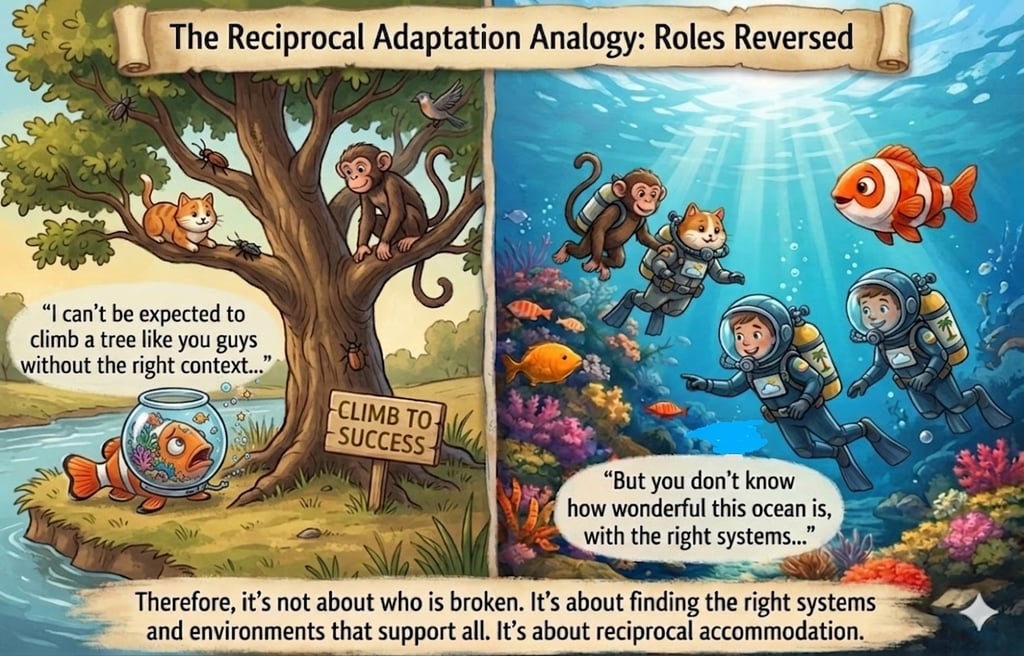
My post content
I. Read This First
Language shapes how we understand ourselves and how we interpret other people.
Many commonly used clinical terms describe neurodivergent experiences primarily from the outside looking in. They often name what an observer sees: difficulty starting, intense emotions, missed deadlines, inconsistent attention, or strong reactions.
But observable behavior does not always explain what is happening internally.
Behind the behavior may be differences in attention, sensory processing, emotional intensity, time perception, executive functioning, or nervous-system regulation.
Without that internal context, neurodivergent people may be described as:
unreliable
too sensitive
overly emotional
not trying hard enough
overreacting
unmotivated
inconsistent
The Inside-Out Framework asks a different question:
Instead of only asking, “What does this behavior look like?” we also ask, “What might this person be experiencing internally?”
Looking from the inside out can provide a fuller picture of the experience and help separate a person's behavior from assumptions about their character, motivation, or effort.
Changing the Language
The Inside-Out Framework encourages language that describes the experience rather than automatically defining it as a deficit.
For example:
Time Blindness → Time Perception Difference
This shifts the focus from being “blind” to time toward understanding that the perception and tracking of time may operate differently.
Emotional Dysregulation → Emotional Flooding
This emphasizes the experience of emotions becoming intense or overwhelming rather than implying that the person is simply failing to regulate them.
Rejection Sensitive Dysphoria → Rejection Flooding
This describes the rapid and intense emotional response that perceived rejection, criticism, or disconnection may trigger.
Executive Dysfunction → Executive Function Challenges
This recognizes genuine difficulties with processes such as initiation, planning, sequencing, working memory, shifting attention, and task completion without defining the person's executive system as entirely “dysfunctional.”
An Important Clarification
These terms are not official diagnostic labels, nor are they intended to replace established clinical terminology.
They are educational and descriptive terms designed to make internal experiences easier to understand, encourage curiosity about what may be happening beneath observable behavior, and reduce unnecessary shame.
The goal of the Inside-Out Framework is not to deny challenges.
It is to describe those challenges with greater context.
Outside-in tells us what we can observe.
Inside-out helps us understand what the person may be experiencing.
Both perspectives can matter, but neither should be mistaken for the whole person.
What if the behavior we judge from the outside makes perfect sense from the inside?
Much of the language used to describe ADHD, Autism, and AuDHD begins with what other people can observe:
A teacher sees a student with ADHD staring out the window and concludes that they are not paying attention.
A partner sees an unfinished task and interprets it as laziness or a lack of effort.
A clinician observes difficulty with transitions and describes an Autistic person as rigid or inflexible.
An employer notices lateness, disorganization, or inconsistent performance and assumes an ADHD employee is unreliable.
These observations may identify real patterns, but they do not automatically explain what is happening inside the person. When behavior is interpreted without understanding the internal experience, a neurological, emotional, sensory, or environmental difficulty can easily be mistaken for a character flaw.
Visible behavior is an outcome. It is not a complete explanation.
The Inside-Out Framework begins with a different question:
What is the person experiencing internally, and what conditions may be shaping the behavior we can see?
This shift matters because the explanation we choose influences the response that follows. When behavior is interpreted as a character problem, the response is often pressure, correction, criticism, or shame. When the experience is understood more accurately, the response can become curiosity, accommodation, and targeted strategy. The Inside-Out Framework offers a practical way to move from observing neurodivergent behavior to understanding the person experiencing it
In a nutshell...
The Inside-Out Framework is a way of interpreting neurodivergent experiences from the perspective of the person experiencing them.
Instead of beginning with judgment, comparison, or compliance, the framework begins with curiosity.
It asks:
What is happening internally?
What is the person noticing in their body, thoughts, emotions, attention, or sensory system?
What demand is being placed on the nervous system?
What environmental conditions are helping or interfering?
What need, barrier, or regulation process may be present?
What support would address the actual difficulty?
The framework does not dismiss observable behavior. It places behavior in context.
For example:
Outside-in description: “Autistic individuals are rigid.”
Inside-out investigation: “Predictability may be helping their nervous system remain regulated.”
Outside-in description: “ADHD individuals are often inattentive.”
Inside-out investigation: “Their attention may be internally directed, repeatedly interrupted, or difficult to shift.”
Outside-in description: “AuDHD individuals often overreact.”
Inside-out investigation: “Their emotional response may have escalated into emotional flooding before they could process or regulate it.”
Outside-in description: “Autistic individuals lack empathy.”
Inside-out investigation: “They may experience or communicate empathy through a different pathway, timing, or social style.”
The inside-out description does not excuse every behavior or eliminate responsibility.
It provides a more useful starting point for understanding what happened and determining what should happen next.
II. Examples of Inside-out reframes
Explore
⚠️ Educational notice: Learning how your brain works can support self-understanding, reduce shame, and help you advocate for your needs. Educational resources do not replace individualized professional support. For many people, education, therapy, coaching, medication, accommodations, and community support work together. Read the educational disclaimer.
Terms of Use
© 2026 AUplusDHD , a project of TNAZ Designs & Services, LLC. All rights reserved.
Support
Legal